The Moment a Vegetable Broke Your Brain (And Why You've Never Cooked the Same Way Since)
Somewhere in your memory, there's probably a food. Not a dish from a three-star restaurant, not a childhood holiday meal, but a single ingredient — eaten at the right moment, in the right place — that quietly rearranged something in you.
For a lot of vegetable cooks, that moment involves a tomato.
It almost always involves a tomato.
But it doesn't have to. Plenty of people have had their culinary worldview shattered by a carrot pulled from the ground and eaten still dirty, or a corn cob roasted over an open fire at a roadside stand in Iowa, or a fig — warm from afternoon sun — eaten directly off a branch in someone's backyard in California. The vegetable almost doesn't matter. What matters is that it tasted like nothing you had ever eaten before, and that afterward, the version of that vegetable you'd been accepting your whole life felt like a polite lie.
Food scientists have a term for the cognitive dissonance that follows: expectation violation. Your brain had built a model of what a tomato tasted like based on decades of accumulated experience — mostly supermarket tomatoes, picked early, gassed with ethylene to simulate ripeness, shipped across the country in refrigerated trucks. And then something came along that didn't match the model at all, and your brain had to update everything.
That's not a small thing. That's a recalibration.
What's Actually Happening in Your Mouth
The science behind why a truly exceptional vegetable tastes so different from its grocery store counterpart is, at this point, fairly well understood — even if the experience still feels a little miraculous.
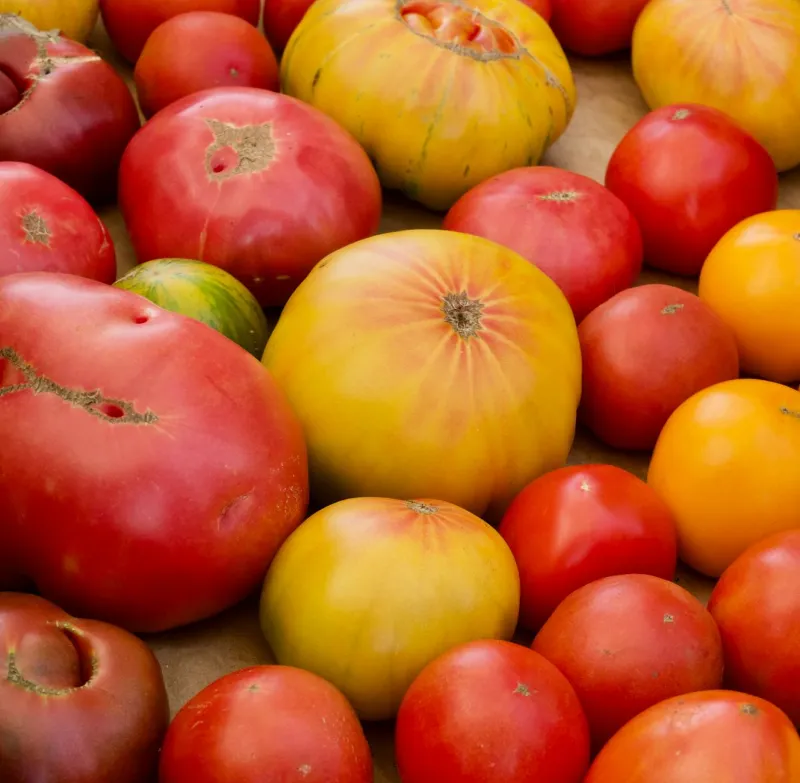
Take the tomato. A commercially grown tomato is bred primarily for uniform size, thick skin (so it ships without bruising), and a long shelf life. Flavor, in that equation, is an afterthought. The volatile aromatic compounds — the ones that create the complex, almost floral top notes of a great tomato — are highly fragile and deteriorate rapidly after harvest. Cold storage accelerates that deterioration. By the time a standard supermarket tomato reaches your kitchen, many of those compounds are simply gone.
A tomato grown for flavor — a Sun Gold cherry tomato warm from the vine, or a Cherokee Purple at the peak of a hot August — still has all of them. The sugars are higher. The acidity is balanced rather than blunted. The umami compounds, particularly glutamates, are present in quantities that trigger a measurably different neurological response.
In other words: it's not nostalgia or romanticism. The great tomato genuinely tastes better because it is chemically different food.
The Stories People Tell
When you ask cooks — professional or otherwise — about their vegetable awakening, the stories share a common structure: ordinary expectations, extraordinary experience, and a period of mild grief about all the years spent accepting less.
Amara, a home cook from Chicago who runs a supper club out of her apartment, traces her conversion to a Sunday morning at the Green City Market a few summers ago. She'd been buying tomatoes her whole life. She'd made salads, pasta sauces, salsas. She thought she liked tomatoes.
"A farmer handed me a slice of something called Brandywine," she says. "Just a slice, on a paper plate, with nothing on it. And I actually had to sit down. I know that sounds dramatic, but I had to sit down. I had no idea a tomato could taste like that. And then I was angry, honestly. Where had this been my whole life?"
That anger — or something adjacent to it — is a common feature of the vegetable epiphany. It's the anger of someone who has been underserved by a food system optimized for logistics rather than flavor, and who is only now realizing it.
For others, the awakening is gentler. Marcus, a retired high school teacher in Vermont, had his moment with a carrot. He'd planted a small garden in his backyard during the pandemic, mostly to have something to do. The carrots were the last thing he harvested, well into October after a few frosts.
"I'd read that frost makes root vegetables sweeter," he says. "I figured that was the kind of thing food people say to make themselves feel interesting. Then I ate one of those carrots raw, standing in the garden, and it tasted like candy. Like actual candy. I just stood there in the cold eating carrots for probably twenty minutes."
The frost-sweetening of root vegetables is real and documented — cold temperatures trigger a conversion of starches to sugars as the plant protects itself from freezing. Marcus hadn't invented a feeling. He'd just encountered the chemistry for the first time.
Why This Moment Changes How You Cook
The vegetable epiphany isn't just a nice memory. It functions as a reference point — a sensory benchmark that changes how you evaluate everything afterward.
Food psychologists describe this as the formation of a "peak experience anchor." Once you know what a carrot can taste like at its absolute best, you carry that knowledge into every subsequent carrot encounter. You start noticing the difference between a carrot that's been sitting in cold storage for three months and one that's been in the ground until last week. You start making different choices at the market. You start cooking differently — more simply, often, because you've learned that great vegetables don't need to be obscured.
This is why so many professional chefs describe their first encounter with exceptional produce as a turning point. It's not that they suddenly became better technicians. It's that they recalibrated their entire sense of what they were working with and what was possible.
For home cooks, the effect is often even more pronounced, because the stakes feel more personal. This is your kitchen. These are your meals. The realization that you've been cooking with ingredients that were never performing at their potential isn't just surprising — it's genuinely motivating.
How to Engineer Your Own Epiphany
You don't have to wait for a lucky encounter at a farmers market. You can create the conditions for your own vegetable awakening, deliberately.
Choose one vegetable you think you know well. A tomato, a carrot, a bell pepper, an ear of corn. Find the best version of it you can — from a local farm, a farmers market, or even your own backyard if you have the space. Eat it as simply as possible: raw, or barely cooked, with nothing that would distract from the flavor.
Pay attention to what you notice. The sweetness, the acidity, the texture, the way the flavor lingers or doesn't. Let it be a little bit of an event.
And then, when you go back to buying that vegetable at the grocery store, notice what's different. Not to feel bad about it, but to understand what you're working with — and to know that when the season is right and the source is good, that benchmark flavor is always out there waiting for you.
The vegetable that breaks your brain is out there. It might be a tomato. It might be a radish eaten at a farm stand in rural Ohio. It might be a roasted beet that tastes, inexplicably, like something you've been craving your whole life without knowing it.
When it happens, sit down if you need to. It's worth taking a moment.