Why Restaurant Vegetables Taste Like a Dream (And Yours Taste Like a Chore)
There's a particular kind of culinary heartbreak that happens in home kitchens across America every single night. You order the roasted broccolini at your favorite spot — the one with the crispy tips and the garlicky, lemony something-or-other that makes you scrape the plate — and you think: I could make this. Maybe you even Google it on the way home.
Then you make it. And it's fine. It's perfectly acceptable broccolini. But it doesn't taste like that.
This gap between restaurant vegetables and home-cooked vegetables is real, it's frustrating, and it has almost nothing to do with talent. It has everything to do with a handful of specific techniques and habits that professional kitchens treat as second nature — things that never made it into most home cooking education. Let's break it down.
The Heat Problem (Yours Isn't Hot Enough)
This is the big one. Restaurant kitchens run equipment that gets screaming hot — commercial ranges that throw out 30,000 BTUs or more, convection ovens that circulate heat aggressively, and cast iron or carbon steel pans that have been preheating for twenty minutes before a single vegetable touches them.
Your home oven probably tops out around 500°F, and most recipes tell you to cook at 400°F. That's not bad, but it's not the same as a 550°F convection environment where moisture evaporates almost instantly and caramelization happens fast.
The fix? Crank your oven as high as it will go. Preheat your sheet pan or cast iron skillet inside the oven while it heats up. When you put vegetables onto a ripping-hot surface, they sear rather than steam. That's the difference between caramelized and soggy. It sounds like a small thing. It is not a small thing.
The Fat Ratio That Changes Everything
Here's something restaurant cooks know that the wellness-content corner of the internet has been quietly trying to hide from you: professional kitchens use a lot more fat than recipes suggest. Not in a reckless way — in a precise, intentional way.
When a line cook tosses vegetables before roasting, they're coating every single surface. Not drizzling. Not misting. Coating. Fat conducts heat, promotes browning, and carries flavor compounds deep into the vegetable's surface. Under-fatted vegetables steam in their own moisture and turn pale and soft.
A good rule of thumb: if you think you've used enough olive oil, add a little more. For a full sheet pan of vegetables, you're probably looking at three to four tablespoons minimum. Yes, really. And if you're finishing a sauté in a restaurant kitchen, there's almost always a knob of butter going in at the end — swirled in off the heat to create that glossy, rounded finish that makes everything taste more expensive.
Salt, and When You're Adding It
Restaurant cooks salt in layers and they salt aggressively. Not in a way that makes food taste salty — in a way that makes food taste like itself, only more so.
Most home cooks season at the end, which means the salt sits on the surface and tastes sharp. Seasoning before and during cooking — especially with vegetables that have high water content like zucchini, eggplant, or mushrooms — draws out moisture, concentrates flavor, and allows the salt to integrate into the food rather than announce itself.
For denser vegetables like carrots or beets, a light pre-salt before roasting makes a noticeable difference. For leafy greens hitting a hot pan, salt them as soon as they go in. And for anything finishing with a sauce or butter, taste and adjust right at the end with a pinch of flaky salt. These aren't complicated steps — they're just habits that take a few weeks to build.
The Crowding Issue Nobody Talks About Enough
Sheet pan crowding is the silent killer of home vegetable cookery. When vegetables are packed tightly together, the steam they release has nowhere to go. Instead of evaporating, it pools around the food and essentially braises everything. You end up with soft, pale, vaguely sad vegetables instead of the caramelized, edge-crisped version you were going for.
Restaurants have the advantage of larger equipment and smaller batch cooking — a line cook is often roasting a single portion at a time, not a whole pound of Brussels sprouts for a family of four.
At home, the solution is simple but requires commitment: use two sheet pans instead of one, and don't be afraid to leave space. Vegetables should be in a single layer with actual breathing room. If your pan looks sparse, that's correct. Resist the urge to consolidate.
The Finishing Move You're Skipping
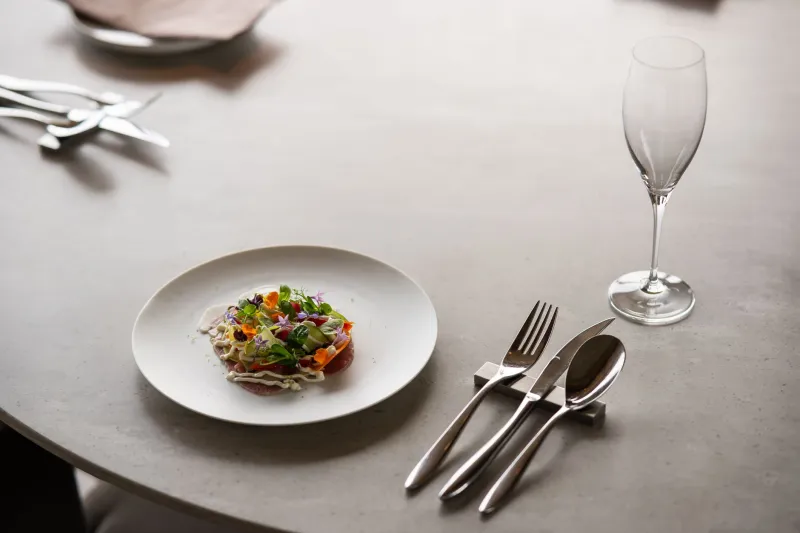
Restaurant vegetables rarely come off the heat and go straight to the plate. There's almost always a finishing step — a hit of acid, a scatter of fresh herbs, a drizzle of good oil, a handful of something crunchy, a swipe of something creamy underneath.
These finishing elements aren't garnish. They're structural. A squeeze of lemon over roasted cauliflower right before serving wakes up every flavor on the plate. Fresh herbs added at the last second (not cooked in) bring brightness that cooked herbs can't replicate. A spoonful of labneh or tahini underneath a pile of charred green beans turns a side dish into something people talk about.
This is the easiest gap to close, and it requires almost no technique — just the habit of pausing before you plate and asking: what does this need?
Timing Is a Skill, Not a Suggestion
Restaurant cooks develop an almost intuitive sense of doneness through sheer repetition. They're making the same dishes dozens of times per service, so they learn exactly what properly caramelized fennel looks like, sounds like, smells like.
Home cooks are working from recipe timings that are, at best, approximations. Ovens vary. Vegetables vary. A carrot from your farmers market in July is going to behave differently than a grocery store carrot in February.
The real skill here is learning to cook by sight, smell, and sound rather than the timer. Vegetables should smell nutty and sweet when they're roasting correctly. They should sizzle audibly in a hot pan. The edges should be visibly darkening before you pull them. Start checking earlier than the recipe says, and trust what your senses are telling you.
Closing the Gap
The distance between restaurant vegetable cookery and home vegetable cookery isn't about secret ingredients or professional equipment you'll never have. It's about a cluster of small, specific habits — hotter heat, more fat, better salting, proper spacing, finishing touches, and sensory awareness — that restaurants have baked into their muscle memory and most home cooks were never explicitly taught.
Start with one. Pick the sheet pan thing, or the oven temperature thing, or the finishing acid thing, and do it consistently for a week. You'll notice a difference fast enough to motivate the next one.
Those restaurant carrots aren't magic. They're just cooked by people who've internalized a few principles that nobody ever bothered to write down for the rest of us. Until now.