Stem to Crown: How to Break Down Cabbage, Cauliflower, and Broccoli Without Wasting a Single Leaf
Here's a scene that plays out in kitchens across America every single week: someone pulls a head of cauliflower out of a grocery bag, hacks off the florets with increasing frustration, and tosses the dense white core and half the stem straight into the compost. Maybe they feel a little bad about it. Maybe they don't think twice.
Either way, they just threw away some of the best parts.
Breaking down cruciferous vegetables — the dense, leafy, architecturally complex family that includes cabbage, cauliflower, and broccoli — is one of those skills that looks simple until you realize you've been doing it inefficiently for years. The good news? Once you understand the structure of each vegetable, the whole process clicks into place. You get more food, better results in the pan, and a relationship with your produce that actually respects what it took to grow.
Let's get into it.
First, Know What You're Working With
All three of these vegetables share a common architecture: a dense central core or stem, branching structures that radiate outward, and outer leaves that most people treat as packaging. Understanding that anatomy is the first step to breaking them down intelligently.
Broccoli is essentially a tree — a thick central stalk that branches into smaller stems, each topped with tight clusters of flower buds (those are the florets). The outer leaves are edible. The stalk, often discarded, is arguably the most versatile part of the whole thing.
Cauliflower is more compact — a single dense curd (the white head) made up of tightly packed florets attached to a central core, surrounded by a layer of protective leaves. The core is firm and slightly sweet. The leaves are tender and delicious when roasted.
Cabbage is a layered sphere: tightly wound leaves that get progressively more tender toward the center, all anchored to a dense, woody core. The outer leaves are tougher but great for wrapping or long braises. The core, often discarded, is crunchy and mild.
Breaking Down Broccoli
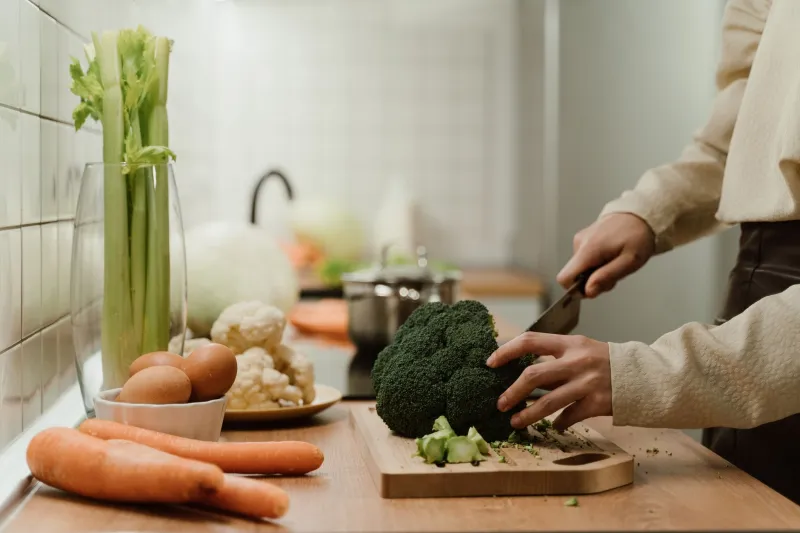
Start by laying the head on your cutting board and slicing off the very bottom of the stalk — just a thin trim, like you're freshening up a bouquet of flowers. Then stand the broccoli upright and use a sharp chef's knife to shave off the outer skin of the stalk in long downward strokes. That fibrous outer layer is what makes raw broccoli stem taste tough. Once it's gone, you've got a pale green cylinder that's sweet, firm, and incredible sliced thin for salads or cut into coins for stir-fries.
Next, separate the crown from the stalk by cutting where the branches begin to fork. From there, work with your hands as much as your knife — pull the larger branches apart at their natural joints before cutting. This gives you cleaner, more natural-looking florets with less crumbling. For the smaller florets at the top, a paring knife is your friend.
Common mistake: Cutting straight down through the crown from the top. This creates uneven pieces, wastes florets, and sends tiny green bits flying everywhere. Always cut from the stem side up.
Why it matters for cooking: Florets cut with their stems intact have more surface area and cook more evenly. Stems and florets roast at different rates, so if you're roasting, cut stems slightly thinner than florets to even things out.
Breaking Down Cauliflower
Cauliflower rewards patience more than any of the three. Start by pulling away the outer leaves — don't throw them away. Toss them with olive oil and roast them until crispy. They're like kale chips but better, and if you've never tried them, you're overdue.
Flip the head upside down so the core faces up. Cut straight down through the center to halve it, then quarter it. Now you can see the internal structure: the florets are attached to the core by small branching stems. Use the tip of your knife to cut along those natural seams rather than sawing through the curd. The florets will release cleanly with minimal crumbling.
The core itself — that dense, ivory wedge — should be sliced thin and roasted or eaten raw. It's nutty, slightly sweet, and has a satisfying crunch that disappears completely if you overcook it.
Common mistake: Trying to break cauliflower apart from the top. The curd is dense and tightly packed; forcing it apart from above creates a mess of crumbles. Always work from the stem side.
Why it matters for cooking: Cauliflower's high water content means surface area is everything for roasting. Bigger, flatter pieces with more exposed surface will caramelize beautifully. Tiny crumbles just steam and go soggy.
Breaking Down Cabbage
Cabbage is the most forgiving of the three, but it's also the one most people under-utilize. Start by peeling off any damaged outer leaves — but if the outer leaves are intact, save them. They're ideal for stuffed cabbage rolls, wraps, or long braises where you want something that holds up.
Halve the cabbage through the core. You'll see the layered structure clearly now. For shredding or slicing, place each half flat-side down and cut crosswise into ribbons. For wedges — which are spectacular roasted or grilled — cut each half through the core again so each wedge retains a piece of core that holds the leaves together during cooking. This is the key move most people miss: if you remove the core before roasting wedges, the whole thing falls apart on the sheet pan.
For the core itself, once you've finished slicing: dice it fine and add it to soups, or slice it thin and pickle it. It has a clean, mild flavor that takes on whatever you put around it.
Common mistake: Removing the core entirely before cooking cabbage wedges or steaks. The core is structural — it's what keeps your wedge together in the oven or on the grill.
Why it matters for cooking: The density of cabbage leaves means they cook at very different rates depending on how they're cut. Thin ribbons wilt quickly and are great for quick sautés. Thicker wedges need high heat and time to caramelize properly. Knowing how you're going to cook it should determine how you break it down.
The Bits You're Probably Still Throwing Away
Let's do a quick audit of what's worth saving across all three vegetables:
- Broccoli leaves: Sauté them with garlic and olive oil. They taste like a cross between broccoli and kale.
- Cauliflower leaves: Roast until crispy. Genuinely one of the best vegetable snacks going.
- Broccoli and cauliflower stems: Peel, slice thin, and use in slaws, stir-fries, or grain bowls.
- Cabbage core: Pickle it, dice it into soups, or slice thin for raw salads.
- Outer cabbage leaves: Blanch and use as wraps, or braise low and slow until silky.
A Note on Your Knife
None of this works as well with a dull blade. A sharp chef's knife is especially important with cauliflower — its density means a dull knife will slip and skid in ways that are genuinely dangerous. If your knife is dragging rather than gliding, sharpen it before you start. Your hands will thank you, and so will your florets.
Breaking down cruciferous vegetables well isn't about being fancy or cheffy. It's about understanding that every part of the plant was grown with care, and that a little technique is the most direct way to honor that. When you stop treating the stem as an obstacle to the floret, a whole lot of your cooking gets better — and your compost bin gets a lot lonelier.
That's a trade worth making.