How You Cut It Changes Everything: A Home Cook's Guide to Knife Skills That Actually Matter
Let's start with a carrot. Humble, ubiquitous, probably rolling around in the back of your crisper drawer right now. Slice it into thick rounds and roast it—you get something sweet and a little dense, with caramelized edges and a satisfying chew. Now julienne that same carrot into thin matchsticks and toss it raw into a slaw—suddenly it's bright, crisp, almost grassy. Finally, shave it paper-thin on a mandoline and dress it with citrus and herbs, and you've got something delicate and almost floral. Same vegetable. Same farm. Same week. Wildly different experiences.
That's the quiet power of the knife. And it's the thing most home cooks overlook when they're trying to level up their vegetable cooking.
It's Not About Showing Off. It's About Science.
Here's what's actually happening when you change your cut: you're changing the surface area exposed to heat, acid, fat, or air. More surface area means faster cooking, more browning, more absorption of whatever sauce or dressing you're working with. A fine brunoise—those tiny, precise little cubes you see in restaurant soups and composed salads—cooks almost instantly and releases flavor quickly into a dish. A rough, chunky dice holds its shape, retains more moisture, and gives you something to actually bite into.
Cut direction matters too. Slicing a leek into thin rounds gives you rings that separate and melt into a braise. Cutting that same leek on a sharp bias—diagonal, elongated slices—gives you more surface contact with a hot pan, faster caramelization, and a more elegant presentation. You didn't change the ingredient. You changed the physics.
This is why professional cooks obsess over knife work. It's not gatekeeping or culinary theater. It's literally about making food taste better.
The Cuts Worth Learning First
You don't need to memorize a French culinary dictionary to cook great vegetables at home. But a few key techniques will genuinely transform your everyday cooking.
Chiffonade is the move for leafy greens and herbs—stack your leaves, roll them tight like a little cigar, and slice across into thin ribbons. Do this to fresh basil and it stays bright and beautiful instead of bruising into black mush. Do it to kale or Swiss chard and you get delicate strips that wilt evenly and quickly in a hot pan. It's fast, it's practical, and it makes everything look intentional.
Brunoise sounds intimidating but it's really just a very small, very consistent dice—think about an eighth of an inch on each side. It's the technique behind a well-made soffritto or a finely textured vegetable filling. Onions and celery cut this small disappear into a sauce, contributing flavor without bulk. Bell peppers brunoise'd into a corn salad add little pops of sweetness without dominating the texture. Precision here is less about perfectionism and more about even cooking—when all your pieces are the same size, they cook at the same rate.
The bias cut is your secret weapon for stir-fries, grain bowls, and anywhere you want vegetables to look intentional and cook evenly. Angle your knife at about 45 degrees and slice across. You get more surface area, more caramelization potential, and a shape that honestly just looks better on the plate. Try it on zucchini, asparagus, green beans, or snap peas.
Rough chop vs. fine mince might seem obvious, but it's worth being intentional about. A rough chop on garlic gives you distinct, slightly toasty pieces that announce themselves in a dish. A fine mince melts into sauces and dressings, contributing flavor without texture. Same ingredient, completely different role depending on how you approach it.
Your Knife (and How You Use It) Actually Matters
Before we go further—let's talk about the tool itself. You don't need a $300 Japanese chef's knife to cut vegetables well. But you do need a sharp one. A dull knife is slower, less precise, and genuinely more dangerous because you end up forcing it through food instead of guiding it. A $40 chef's knife that you keep sharp with a honing steel will outperform an expensive blade you've never touched up.
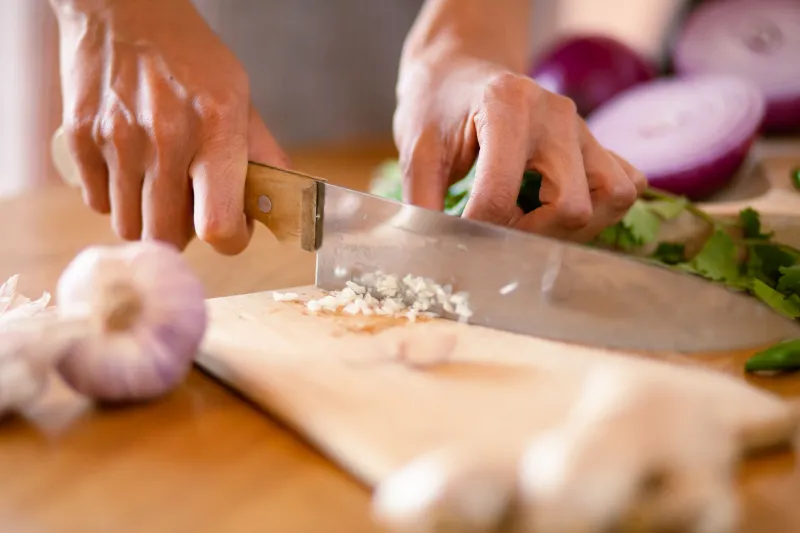
Most home cooks also hold their knife wrong. The pinch grip—where your thumb and index finger pinch the blade itself, just above the handle—gives you far more control than gripping the handle alone. It feels weird at first. Then it feels like the only way.
And your non-knife hand? Curl your fingers into a "claw" shape, with your knuckles guiding the blade. It protects your fingertips and lets you move steadily through the vegetable without hesitation. These two adjustments alone will make your prep faster and your cuts more consistent.
The Same Vegetable, Three Ways: A Quick Case Study
Let's return to that carrot, because it really is the perfect illustration.
Thick oblique cut, roasted at 425°F: The oblique cut (also called a roll cut—rotate the carrot a quarter turn between each diagonal slice) creates irregular, multi-faceted pieces that maximize surface contact with the pan. You get deep caramelization, a tender interior, and a rustic, hearty presentation. This is your side dish.
Fine julienne, dressed raw: Matchstick-cut carrots in a sesame-ginger slaw stay crunchy and bright. The thinness means the dressing penetrates quickly, and the texture contrasts beautifully with softer components. This is your fresh, acidic counterpoint.
Paper-thin shavings, quick-pickled: Use a vegetable peeler or mandoline to get translucent ribbons. Toss them in a quick brine of rice vinegar, a little sugar, and salt for 20 minutes. You get something delicate, tangy, and visually stunning draped over tacos, grain bowls, or a simple piece of roasted fish. This is your finishing move.
Same vegetable. Three completely different outcomes, driven entirely by the cut.
Making It a Practice, Not a Project
The honest truth about knife skills is that they only improve with repetition. You don't need to block off a weekend to practice—just be intentional a few nights a week. Choose one technique and apply it deliberately. Chiffonade your herbs instead of tearing them. Julienne your bell pepper instead of rough-chopping it. Notice what changes.
Over time, you'll start to see your vegetable prep not as a chore you rush through to get to the cooking, but as the first creative decision you make in the kitchen. How you cut it sets the tone for everything that follows—the texture of the final dish, how it absorbs seasoning, how it looks on the plate, and honestly, how much you enjoy eating it.
That's not a small thing. That's the whole game.
So sharpen your knife, find your claw grip, and give that carrot the respect it deserves. You might be surprised what it gives you back.